



macOS · Windows · LinuxiOS · Android
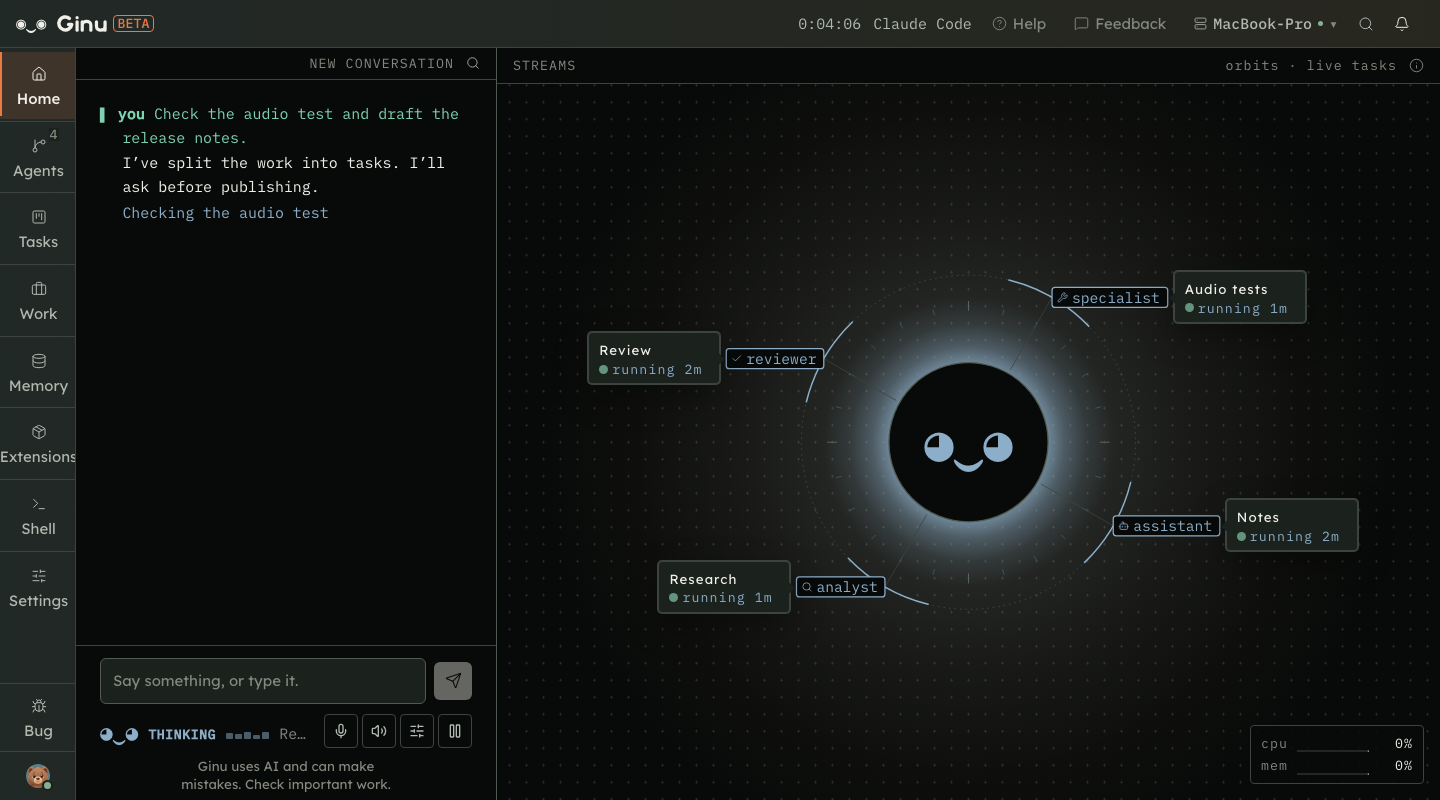
Ginu running four example tasks beside a conversation. Research, audio tests and release notes continue while a review needs your decision.
Inside Ginu · recorded in the app with example tasksClaude Code / Codex / Gemini
Why voice

Agents got autonomous.
I didn’t get faster at typing.

When several agents are working at once, the scarce resource is not compute, it is your attention. Every time you stop to read a terminal you pay a context switch, and the agents wait for you at exactly the point where you are slowest.

Read why interruptions work differently

Saying “spawn someone to chase that flaky test, and show me the auth diff when it’s ready” takes three seconds and no context switch. Ginu runs both. The harder half is the other direction, and it is the part I actually built: it stops interrupting you while you are thinking. A routine completion waits for a gap in the conversation. A worker that has been blocked on you for three minutes earns the right to interrupt. Something irreversible does the opposite of shouting — it waits for a genuine break and is framed slowly, because a decision you cannot undo must never arrive as a yes-or-no that a reflexive “yeah” could approve.

You can believe that because none of it is a notification setting. Every piece of news is scored against the room — whether a turn is in flight, whether Ginu is already speaking, whether you are mid-sentence, how long it has been quiet — by a policy that is a file you can read. An agent cannot mark its own news urgent: it reports facts, and the policy turns facts into a number, which is the only reason everything here isn’t P1. And every decision it made is a line in a log with the evidence it had.

A conversation that keeps up.

Timed in real sessions.

Speak about four times faster than you type.

150 words a minute spoken, 40 typed.

It answers out loud, right away.

Keeps replies flowing.

Talk over it and it stops.

Interrupting is just talking.

Playback block size, not end-to-end interruption latency.

Your voice stays on your computer.

See the full measurements
How the numbers above were measured
What was measured, and howValue
Transcription speed compared with the length of the audio: warm, timed in a real session on an M-series Mac. Long turns are transcribed in pieces while you talk. This is not a comparison with typing.about 18× real time
Speech synthesis speed compared with the length of the audio: warm, timed in a real session on an M-series Mac. Replies are spoken a sentence at a time.about 4× real time
Playback block size, 43 ms; a cut-in stops playback at the next block. This does not measure recognition or end-to-end interruption latency.43 ms
Time to the first agent response in per-turn timing logs, measured with Claude Code. Includes provider latency; it is not a local speech-processing figure.about 3 s
Cloud round trips for speech, by architecturenone

Measured on an M-series Mac. Yours will differ with hardware; the same timing line is written to your transcript on every turn.

Keep the whole picture

Work carries on.
Your attention
stays yours.

File the next few things. The board shows what is running, what finished, and the one card that is blocked on an answer from you.

Read more

Queued tasks are records on disk, so they are still there after a restart. A high-priority one starts the moment you file it, and nothing already running is paused to make room.

See how tasks work
Four tasks. One clear picture.

One decision needs you. The rest keeps moving.

2 running1 needs you1 ready

An illustrated example using Ginu’s task states.

Built around you

Six things it does.
None of them typing.

Pick one to see how it works.
ConversationInterrupt it mid-sentence.
DelegationSend the work somewhere else.
OvernightFile the work, then leave.
Your sayNothing irreversible happens quietly.
Your memoryIt remembers, in files you can read.
From your phoneTake the session with you.
01 / 06 · Illustrated example

One session, microphone open throughout.

Ginu keeps listening while it speaks, so cutting in is just talking. It stops, hears you, and answers the new thing.

Read more

A short “mm” or “yeah” is read as backchannel and does not stop it. Words do.

Try saying

“Wait—check the audio test first.”

Explore conversation
02 / 06 · Illustrated example

Each agent in its own copy of the code.

A delegated task is a separate process on its own git branch and worktree. Nothing it does reaches your working tree until you accept it.

Read more

Open its live terminal to watch the real process, and type into it to redirect the work mid-run.

Try saying

“Look into that failing audio test while I work on the design.”

Explore delegation
03 / 06 · Illustrated example

A queue that outlives the session.

Queued tasks are records on disk, not lines in a chat. They survive a restart, each with its result and whether its branch merged.

Read more

A high-priority agent task starts the moment it is filed. Nothing already running is paused for it.

Try saying

“Work through these tasks and tell me what needs my attention.”

Explore overnight
05 / 06 · Illustrated example

Memory you inspect and correct.

What Ginu learns about your work is a tree of notes on your own disk, each one keeping the belief it replaced.

Read more

A guess is labelled assumed until you confirm it, and correcting one is a sentence: “that’s wrong, it’s pnpm”.

Try saying

“What did we decide about this project last time?”

Explore your memory
06 / 06 · Illustrated example

A paired phone, for as long as you set.

Open a pairing window on your computer, scan it with any phone, and the same conversation and tasks appear in its browser. Your computer still does the work.

Try saying

“How are the tasks going? Is anything waiting for me?”

Explore from your phone
Personal should mean yours

Your voice stays close.
Your context stays with you.

Speech is recognised and spoken on your computer, so no audio is sent anywhere. Memory is a tree of notes in files you own, ready to read and correct.

What still leaves your computer

The text does. Your chosen CLI sends the transcribed turn and the context it needs to its own provider — Claude Code to Anthropic, Codex to OpenAI, Gemini to Google. Ginu has no server in that path.

Understand what goes where
Start with one useful conversation

What would you
like to get done?

Bring a real project. The first conversation is worth more than the first demo.

It's an open beta, and it's free.